




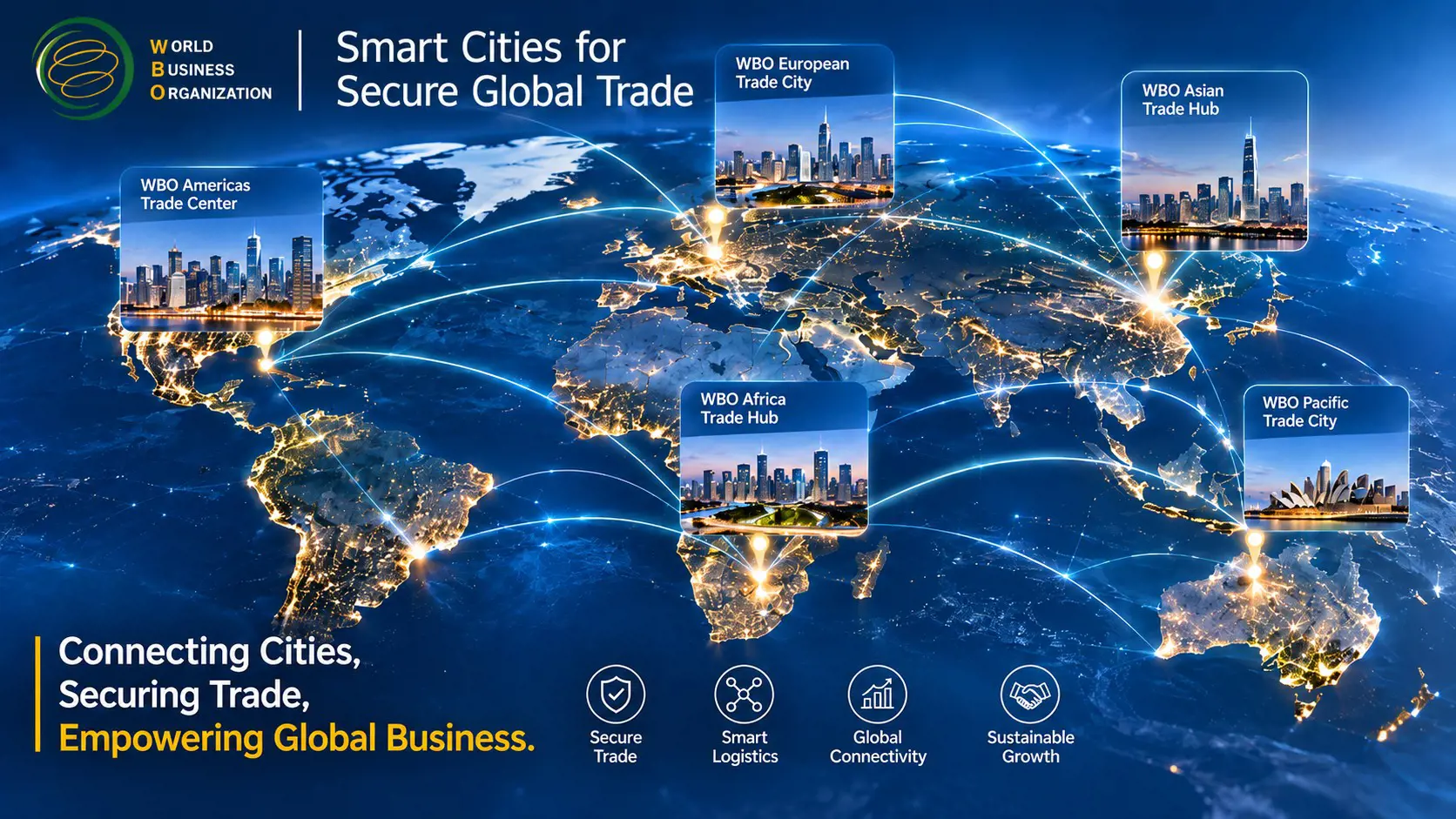
Building a New Infrastructure for International Trade, Logistics and Economic Cooperation
The World Business Organization (WBO) is advancing its strategic vision for the development of Smart Cities for Secure Global Trade, an international initiative designed to address one of the most important challenges facing the modern global economy: the fragmentation of international trade, logistics, and distribution networks.
As global commerce becomes increasingly interconnected, traditional approaches to transportation, customs procedures, warehousing, financial transactions, and goods distribution are facing growing operational challenges.
Delays at borders, fragmented information systems, insufficient coordination between logistics operators, security risks, and rising transportation costs continue to affect the efficiency of international supply chains.
WBO's Smart Cities for Secure Global Trade initiative seeks to address these challenges through an integrated model connecting urban infrastructure, digital technologies, international business networks, and secure trade services.
1. Why the World Needs Smart Trade Cities
Modern international trade requires more than ports, airports, warehouses, and transportation infrastructure.
It requires coordinated ecosystems in which producers, exporters, importers, financial institutions, customs authorities, logistics companies, distribution centers, and technology providers can operate through compatible systems.
The proposed WBO model envisions cities functioning as strategic international trade hubs, connecting regional production capacities with global markets.
These cities could provide an integrated environment for commercial transactions, cargo management, international distribution, trade documentation, business verification, and logistics coordination.
The objective is to reduce unnecessary intermediaries, improve operational transparency, and make the movement of goods more predictable.
2. The WBO Integrated Trade Infrastructure Model
The initiative is built around several interconnected components:
- Smart Logistics and Distribution Centers
Development of strategically located logistics facilities connecting ports, airports, railways, highways, warehouses, and regional distribution networks. - Secure International Trade Infrastructure
Establishment of mechanisms for business verification, commercial documentation, transaction transparency, and improved coordination between international trading partners. - Digital Trade and Information Systems
Use of advanced digital platforms, artificial intelligence, data analytics, and interoperable information systems to improve shipment tracking, inventory management, and supply-chain visibility. - International Business Networks
Connecting qualified manufacturers, exporters, importers, investors, distributors, and service providers through WBO's international business network. - Financial and Commercial Coordination
Facilitating access to appropriate financial services, payment infrastructure, trade finance solutions, and commercial cooperation mechanisms through qualified financial partners.
3. How Smart Trade Cities Can Transform Global Supply Chains
One of the most important benefits of this initiative is its potential to improve the continuity of global supply chains.
Under a coordinated trade-city model, products could move through interconnected logistics and distribution facilities with improved access to shipment information and commercial documentation.
For example, an exporter in Asia could connect with a regional distribution center, an international logistics operator, and an importer in Europe through compatible digital systems.
Such coordination could help reduce administrative duplication, improve shipment visibility, optimize inventory levels, and identify potential transportation bottlenecks before they disrupt deliveries.
The same infrastructure could support agricultural products, industrial equipment, pharmaceuticals, consumer goods, and other internationally traded commodities, subject to the applicable regulatory and security requirements.
4. The Role of Artificial Intelligence and Smart Technologies
Artificial intelligence and digital infrastructure could play a central role in the development of these cities.
Potential applications include:
- Predictive analysis of transportation delays.
- Intelligent warehouse and inventory management.
- Real-time cargo monitoring and tracking.
- Automated processing of commercial documentation.
- Risk-based identification of suspicious transactions.
- Optimization of transportation routes and distribution networks.
- Improved coordination between suppliers, carriers, and buyers.
The integration of these technologies could gradually transform traditional logistics facilities into intelligent trade ecosystems.
However, cybersecurity, data protection, system interoperability, and regulatory compliance must remain fundamental design principles.
5. Economic Benefits for Host Countries and International Businesses
The development of Smart Cities for Secure Global Trade could generate economic benefits extending well beyond logistics.
For host countries, these projects could attract foreign investment, strengthen export capacity, create specialized employment, stimulate industrial development, and improve access to international markets.
For businesses, they could offer more efficient distribution channels, improved access to commercial partners, reduced administrative burdens, and better supply-chain visibility.
For investors, the initiative could create opportunities across logistics infrastructure, industrial real estate, digital technologies, transportation, energy systems, warehousing, and financial services.
The model could also provide smaller and medium-sized enterprises with access to international commercial infrastructure that would otherwise be difficult or expensive to develop independently.
6. WBO's International Cooperation Strategy
The World Business Organization views international cooperation as an essential requirement for the development of this initiative.
WBO's approach is based on connecting governments, investment institutions, business communities, logistics operators, technology companies, and international commercial partners.
The Organization's international network and its broader initiatives in global trade development provide an institutional framework for exploring potential partnerships and investment opportunities.
The development of suitable host locations, investment structures, implementation frameworks, and cooperation agreements represents an important part of the initiative's advancement.
WBO also recognizes that successful implementation requires cooperation with national authorities and compliance with the legal, financial, customs, and commercial frameworks of each participating country.
Conclusion: From Traditional Trade Routes to Intelligent Global Trade Networks
The future of international commerce will increasingly depend on the ability to connect production, transportation, finance, information, and distribution within coordinated systems.
Smart Cities for Secure Global Trade represent an opportunity to move beyond fragmented logistics infrastructure toward a more integrated and transparent international trading environment.
For WBO, the long-term vision is to contribute to the development of an interconnected network of strategic trade centers that can facilitate international business, strengthen supply-chain resilience, attract investment, and improve the movement of goods between markets.
The ultimate objective is not simply to build smarter cities, but to help create a smarter global trading system.