




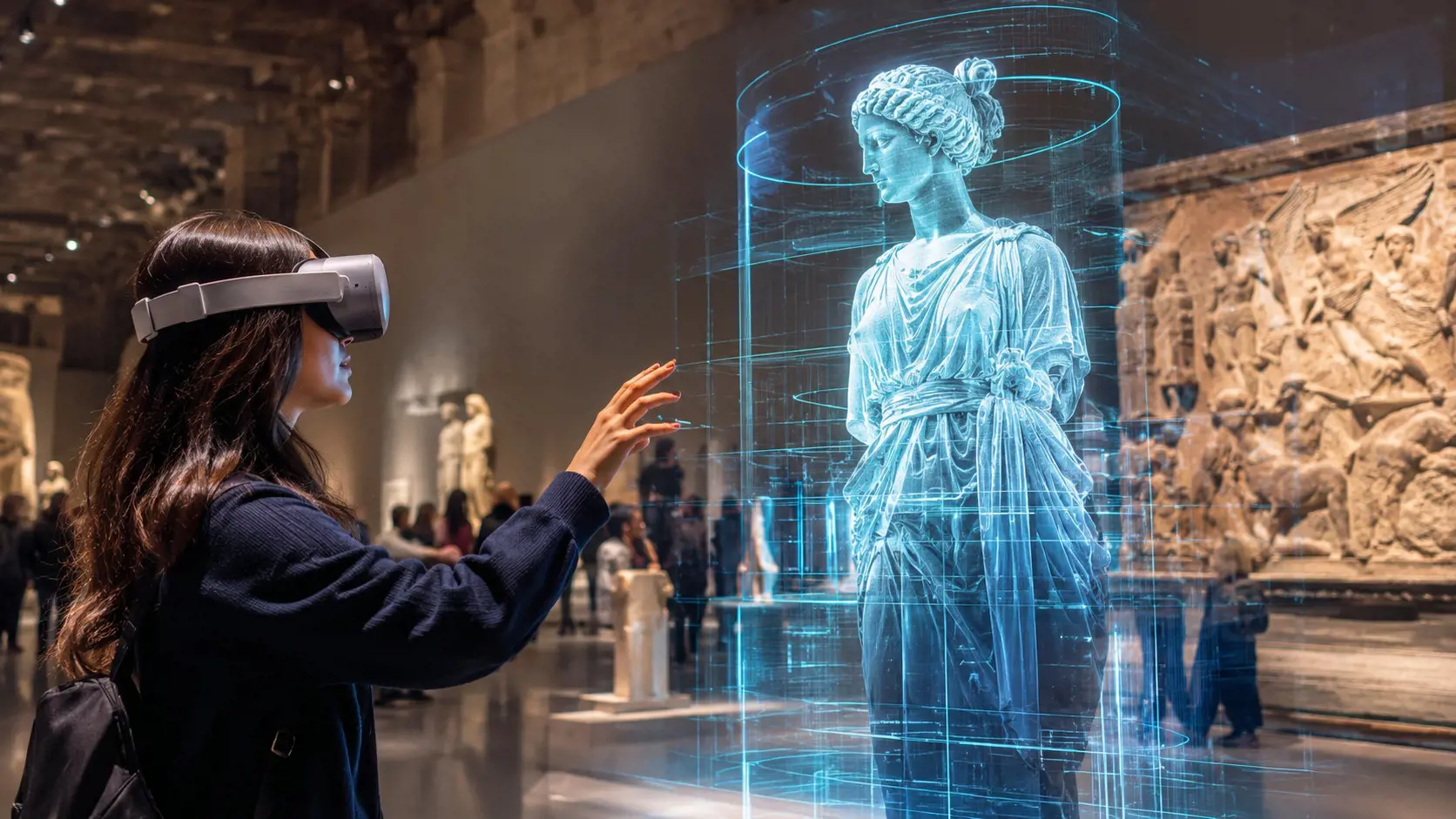
How Technology Is Transforming the Way Humanity Preserves Its Cultural Identity
Human civilization has always depended on its ability to preserve knowledge, transmit cultural experiences, and maintain connections between generations. From ancient manuscripts and archaeological monuments to oral traditions, languages, and artistic expressions, cultural heritage represents one of humanity's most valuable forms of collective memory.
Today, artificial intelligence is introducing a new dimension to this process. Technologies such as machine learning, computer vision, generative AI, and immersive digital environments are changing how societies document, interpret, preserve, and communicate their cultural heritage.
But this transformation raises a fundamental question: Can technology preserve not only the physical evidence of civilization, but also the meanings, identities, and human experiences embedded within it?
1. Beyond Digital Preservation: Creating Intelligent Cultural Memory
Traditional preservation methods have focused primarily on protecting physical objects, historical documents, architectural structures, and artistic collections.
AI is expanding these possibilities.
Advanced image recognition can help researchers identify historical objects, analyze architectural patterns, and detect deterioration in cultural structures. Machine learning systems can also assist in organizing extensive digital archives and identifying relationships between historical documents, languages, and cultural materials.
Recent research published in 2026 highlights the growing integration of artificial intelligence into cultural heritage documentation, conservation, and interpretation.
These developments suggest that cultural preservation is gradually moving beyond passive digital storage toward more intelligent systems capable of supporting historical research and public understanding.
2. Virtual Reality and the Rebirth of Historical Experiences
One of the most significant developments in science and culture is the use of virtual reality (VR) and extended reality (XR) to reconstruct historical environments.
Visitors can increasingly explore digitally recreated archaeological sites, historical cities, museums, and architectural environments.
However, the real scientific challenge is not simply creating visually impressive experiences. It is ensuring that digital environments communicate accurate historical information and help audiences understand the cultural significance of what they are experiencing.
A June 2026 study published in npj Heritage Science introduced an educational framework for cultural heritage experiences using extended reality. Its experimental evaluation involved 84 participants and examined how immersive environments could support cultural understanding and learning.
The research reinforces an important principle: technological immersion should serve knowledge acquisition rather than replace it.
3. The Risk of Losing Cultural Authenticity
Despite its opportunities, artificial intelligence also introduces important cultural and ethical challenges.
AI-generated historical images, reconstructed voices, and digitally recreated environments may blur the distinction between documented historical evidence and computational interpretation.
There is also the risk that cultures with greater digital resources and technological infrastructure could become more visible in global digital environments, while smaller linguistic communities and less-documented traditions remain underrepresented.
Cultural heritage is not simply a collection of data. It contains collective identities, historical experiences, local knowledge, and meanings that cannot always be reduced to algorithms.
For this reason, human expertise, academic verification, and community participation must remain central to the development of AI-based cultural preservation systems.
4. Science, Culture and the Future of Human Civilization
The relationship between scientific innovation and cultural development is becoming increasingly important.
Artificial intelligence can support the preservation of endangered languages, improve access to historical archives, facilitate international research cooperation, and create new opportunities for cultural education.
It can also strengthen cultural tourism and enable institutions to share their heritage with audiences beyond geographical boundaries.
However, the future of cultural innovation should not be measured exclusively by technological sophistication.
Its real value will depend on whether these innovations strengthen cultural diversity, improve access to knowledge, and maintain meaningful connections between past, present, and future generations.
Conclusion: Technology Can Preserve History, Humanity Must Preserve Meaning
Artificial intelligence is changing the infrastructure through which humanity remembers its past.
Yet preserving civilization requires more than collecting information, digitizing monuments, or reconstructing historical environments.
It requires protecting the diversity of human experiences and ensuring that cultural knowledge remains meaningful, accessible, and connected to the communities that created it.
The future of civilization will therefore depend not only on how intelligently humanity develops technology, but also on how wisely it uses that technology to preserve its cultural identity.